Monday, April 7, 2008

Jamie: New Zealand Tattoo

The Maori people are the native indigenous people of New Zealand. They are believed to have lived their since 800 to about 1300AD. They are believed to have come in migration waves from Polynesia, in large ocean going canoes. One of their most idealistic and most recognisable attributes to their history is their traditional tattoo’s.

According to Maori mythology the idea of tattooing derives from an ancient story of love. The young man fights with the princess and she goes to her fathers heavens. The man, filled with guilt goes after the princess. After many trials and obstacles he reaches the fathers realm. His face paint being messed th
e family laugh at him. Then in his state he asks for forgiveness, she accepts and her father then offers to teach the man tattooing. Then after learning the art, he and his princess return as human, with his newly found tattooing skills.
Early Polynesia tattooing was done with bone, or ivory, tools and applied in a chiselling manner. The tattoo’s represented status and those without were considered to have no social class. The head was considered to be the most sacred part of the body and most respectful place to apply the fine art.
The process would begin with the firstly carving deep cuts into the face
 and then applying a deep pigmented soot, or burnt gum, into the face through tapping it into the skin. This process would be very time consuming.
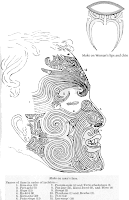
The patterns each have their own meaning and styles. The face was usually divided into eight different sections, each having their own meaning. For men it could act like a passport almost
, showing their rank, lifestyle, marriage and birth status, as well as work.
The male facial tattoo also known as the ‘Moko’, the eight sections are:Ngakaipikirau (rank), The center forehead area
Ngunga (position), Around the brows
Uirere (Hapu rank), The eyes and nose area
Uma (first or second marriage), The temples
Raurau (signature), The area under the nose
Taiohou (work), The cheek area
Wairua (Mana), The chin

Taitoto (birth status), The jaw

The women weren’t as extensively tattooed as the men. Usually they would just get it applied 
to the upper and bottom lip. This ancient tradition has kept on even today in some New Zealanders, though the technique is obviously a lot different.


ROGAN: MAORI TATTOO

The Maori people along with many other Polynesian people believed that a persons life force or ‘mana’ is displayed through their tattoo.  The Ta moko a Maori form of facial tattoo was given to Maori tribesman to indicate their heritage, decent and status in the tribe.  They were also given to signify their exploits and great events in their lives.


 The Maori people were and still are renowned as master carvers and their magnificent wood and stone carvings have covered their totems, buildings, implements and jewellery for hundreds of years.  This carving skill was translated across into tattooing, with moko tattoos literally being carved into the skin with a chisel.  In early times the chisels used were crafted from bone and the blade was quite wide. This supports the fact that early moko designs were quite rectilinear in pattern. However as the art progressed the patterns became more spiral and curvilinear.  These spiral designs have become a major part of what the Maori people are recognized for.

Maori tattoo art has set itself aside from tattooing in the traditional sense due to the fact that Maori tattoos are carved into the skin rather than being punctured.  This slow and painful process gives the tattoo a unique look that you are unable to achieve with a needle.

Maori tattoos have made somewhat of a renaissance in recent years, with the tribal style of tattooing becoming increasingly popular.  However, it is never ok to use a moko pattern for your own design, as they are individual to a Maori person and to replicate them is the ultimate form of plagiary and a direct insult to Maori people.


BIBLIOGRAPHY 

http://www.pbs.org/skinstories/history/newzealand.html

http://history-nz.org/maori3.html

http://www.tao-of-tattoos.com/maori-tattoos.html

http://en.wikipedia.org/wiki/Tā_moko

http://tattoo.about.com/cs/articles/a/maori_tamoko.htm

http://www.tamoko.org.nz/

http://www.newzealand.com/travel/sights-activities/events-calendar/toi-maori/ta-moko-gallery.cfm

http://www.dreadloki.com/pivot/pivot/entry.php?id=701

http://www.freetattoodesigns.org/maori-tattoos.html

http://www.newzealand.com/travel/media/story-angles/art-&-culture/arts-cult_tattoomuseum_storyangle.cfm

Jamie: Gothic Architecture…

The gothic period began in France and went from the 12th Century to the 16th century. This period brought along many new styles and characteristics. This period brought many new styles that have made Europe iconic for such buildings. The period emerged after the renaissance period which made architecture more of an art form than a way to make buildings, all deriving from their roundness arches.

New characteristics that were brought about were higher ceilings, pointed archways, and the ribbed vault. Many architectural buildings that are connected to the gothic architectural period are cathedrals, churches, town halls and even universities. Within these buildings, it is here that the style of gothic really shined to the public.
During the 12th century, Europe was a lot less united and their was peaceful competition between such communities. Much of this was between Germany, France, Italy and Venice during their boom in trade each trying to outdo one another with more technical architectural structures.

Much of their materials to make such beautiful buildings are limestone, granite,
sandstone and marble. Many of the plans are made from the Latin cross base, meaning
that the central design is in the shape of a cross. Another factor of the architecture is the height, generally the churches and cathedrals were taller than they were wide. The new and higher arches began to become the skeleton of the building. With the development of these arches, new styles emerged, the most common being, the Lancet Arch, the Flamboyant Arch, the Depressed Arch and the Equilateral Arch, each holding their own purpose.

These beautiful buildings have become the iconic architecture to Europe during the Gothic period. Such famous buildings include, Clermont-Ferrand Cathedral, Milan Cathedral, and the Chartres Cathedral. Each building holds its own beauty, and power to entice its onlookers.

Bibliography:
http://www.infoplease.com/ce6/ent/A0821376.html
http://en.wikipedia.org/wiki/Gothic_architecture
http://www.historyforkids.org/learn/medieval/architecture/gothic
http://www.bc.edu/bc_org/avp/cas/fnart/arch/gothic/gothic.jpg
http://historylink101.com/lessons/art_history_lessons/ma/gothic_architecture.htmhttp://web.kyoto-inet.or.jp/org/orion/eng/hst/gothic.html

P N G-Face Painting-


Papua New Guinea is one of, or if not the most diverse nations in the world, due to it’s climate and geography
There are hundreds of ethnic groups indigenous to Papua New Guinea, the majority being from the group known as Papuans, whose ancestors arrived in the New Guinea region tens of thousands of years ago.


Papua New Guinea has more languages than any other country in the world, with over 820 indigenous languages, representing twelve percent of the world's total.


A spine of mountains runs the length of the island of New Guinea, forming a densely inhabited highlands region.

People of the highlands engage in colourful native rituals that are called "sing sings".
They paint their faces and body’s, and dress up with feathers, pearls and animal skins to represent birds, trees or mountain spirits.


Sometimes an important event, such as a legendary battle, is
Re-enacted at such a musical festival.


Face and body painting is a complex process of preparation requiring the combined efforts of whole families and tribes.


Formerly, most pigments came from natural clays in yellow, white
and rust colours. Sometimes these were baked in leaf packets to intensify the colour. Other sources were vegetable dyes, charcoal and powdered white lime from shells.
Paint brushes where originally made from chewed up twigs,


Now day’s stores sell packets and bottles of commercial paints, which are favoured for their ease of use and more brilliant colours.


The culture of Papua New Guinea is many-sided and complex. It is estimated that more than a thousand different cultural groups exist in PNG.


Because of this diversity, many different styles of cultural expression have emerged; each group has created its own expressive forms in art, dance, weaponry, costumes, singing, music and architecture.


BIBLIOGRAPHY
http://en.wikipedia.org/wiki/Papua_New_Guinea
http://www.art-pacific.com/artifacts/nuguinea/bilas/bodyart/pigment/pigmenta.htm
http://www.artforconservation.org/cristina.htm
http://encarta.msn.com/media_461531274/papuan_mask.html
http://en.wikipedia.org/wiki/New_Guinea
http://en.wikipedia.org/wiki/Music_of_Papua_New_Guinea

Josh - OCEANIA - New Zealand


Tiki
The word Tiki means Penis and is regarded as a good luck charm when worn and in some areas is also regarded as a fertility symbol. It is a very ancient symbol. The greater meaning isn’t understood, so there are a number of legends about its meaning. Some say he came from the stars and that he was the first man of the world. He is also often depicted with webbed feet which suggest a strong link to the creatures of the sea.

The Maori carvings have special significance. The pre-European Maori had no written language so tribal history and the stories of the gods were kept with the complex wood, bone, shell and jade carvings that were handed down through generations of tribal elders and became sacred objects "Taonga" in telling the history of a tribe and taking on the spirits of past great leaders and warriors.
Pendants, jewelry and various tools such as needles, spear tips and fish hooks made from bone developed into a fine art form with great importance being placed on every piece, many of which took years to make using stone tools. Some have inlays of precious stones or colourful shell. Every piece has a meaning behind the design.
The Maori have a great respect for nature and have many legends about the creation of the earth. Many of these legends revolve around the spirits or gods who created or protect each part of their world such as the mountains, the forests, the lakes and the creatures of the sea. This is seen in the smooth curves of the tiki’s
There are two kinds of Jade, Jadeite and Nephrite. The common names for Nephrite are Greenstone. Nephrite is found in New Zealand, Australia, Canada, and Russia. Nephrite is a silicate of calcium and magnesium and Jadeite is a silicate of sodium and aluminum.


http://www.aotearoa.co.nz/tiki/about.htm
http://jadefactory.com/wa.asp?idWebPage=16512&idDetails=106
http://www.teara.govt.nz/1966/M/MaoriArt/MeaningAndSymbolism/ENZ-Resources/Standard/3/en
http://blog.humuhumu.com/category/australia-new-zealand/
http://www.aotearoa.co.nz/tiki/gallery.htm

ALEC: Hawaiian Tattooing


Imagine having a sharp claw, beak or fish tooth dripping with ink plunged into your skin. Feels comfortable? Well to early Hawaiian society this was just a simple part of life. Whether it be for celebration or self expression tattooing with these quintessential tools has deep roots within the Hawaiian and wider Polynesian culture. It is also form of identification and a representation of a particular tribe.


Traditional tools used for the art of tattooing were mainly found objects from nature; whatever the tattooist could get their hands on. There was no set tool. Tattoo artists would sharpen the object against rocks to achieve and maintain optimal sharpness.


Not only were tattoos eye catching but often had a deeper more personal meaning than their Polynesian neighbours. Hawaiian tattoos on a mans body signified a benchmark of status. The defining characteristics of a high status tattoo included the quantity of ink applied to the face as well as the intricacy of the patterns. Being a chief or part of a chief’s family with in a society meant that you were worthy of ‘getting ink’ from highly skilled artists. Tattoos were mainly reserved for the face but it was not uncommon for women to display tattoos on their hands, feet, fingers and calves Women’s tattoos and the general public got their tattoos from apprentices’ artists.


The designs involved in Hawaiian tattooing evolved from flowing geometrical and symmetrical artworks into more pictorial forms as European influence began to infiltrate their culture.

http://farm1.static.flickr.com/29/65056523_72396ea0a6.jpg

www.indianchild.com/art/traditional_hawaiian_tattoos

Sunday, April 6, 2008

JADE_Samoa


Samoa

Samoa was first settled some 3,000 years ago when people from South East Asia began to migrate towards the Pacific islands.

Samoans had gods of their own. The Samoan culture is centered around the principle of vāfealoa'i, the relationships between people. These relationships are based on respect, or fa'aaloalo. When Christianity was introduced in Samoa, most Samoan people converted. Currently 98% of the population identify themselves as Christian. The other 2 percent either identify themselves as irreligious, or do not belong to any congregation.

As with many Polynesian islands with significant and unique tattoos, Samoans have two gender specific and culturally significant tattoos. For males, it is called the tatau and consists of intricate and geometrical patterns tattooed that cover areas from the knees up towards the ribs. A male who possess such a tatau is called a soga'imiti. A Samoan girl or teine is given a malu, which covers the area from just below her knees to her upper thighs.

One area of Samoan design, which really stands out, is in the construction of Samoan fale. The roof of the building was made from a very complex arrangement of rafters and beams, bound together in a special way with rope made of sinnet. This method of construction leads to the formation of superb patterns on the inner surface of the roof.
The graphic arts seem to be equally devoid of activity with the exception of one area, that of tapa. Tapa is a material usually made from the inner bark of the paper mulberry tree. In Samoa it served as clothing, sail material and a way of expressing wealth. It was usually decorated with a reddy-brown or black pigment in intricate geometrical designs.
http://en.wikipedia.org/wiki/Samoa
http://www.state.gov/r/pa/ei/bgn/1842.htm
https://www.cia.gov/library/publications/the-world-factbook/geos/ws.html
http://www.infoplease.com/ipa/A0108149.html
http://www.samoa.co.uk/
http://www.state.gov/r/pa/ei/bgn/1842.htm
http://www.janeresture.com/samoahome/index.htm
http://www.samoa.co.uk/history.html
http://www.janesoceania.com/samoa_chron_history/
http://history1900s.about.com/library/world/blxsamoa.htm